📊 Betlytic AI Analytics Glossary
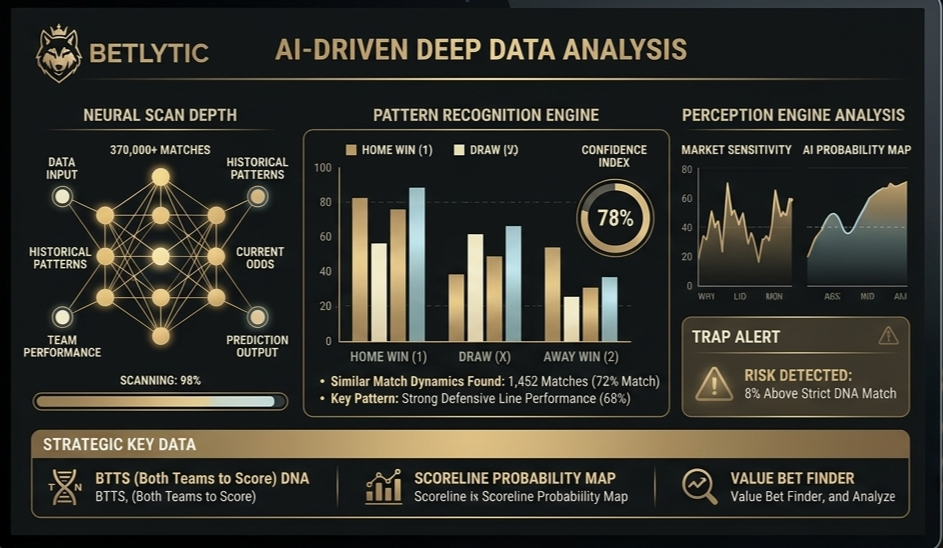
Welcome to the Betlytic Knowledge Base. Our platform operates on a complex neural engine that processes over 370,000+ historical matches. To help our users make data-driven decisions, we have defined the key metrics and statistical models used by our AI.
🧠 1. Advanced AI & Neural Metrics
| Metric Name | Neural Focus | Data Scope |
|---|---|---|
| AI Perception Engine | Market Bias Detection | 370,000+ Matches |
| DNA Similarity | Pattern Matching | Historical Twins |
| Trap Alert | Risk Management | Volatility Scan |
| Monte Carlo | Probability Convergence | 10,000 Simulations |
AI Perception Engine
The core of Betlytic's intelligence. This metric measures the correlation between current market odds (expectations) and 370k+ historical data points (reality). If the market heavily favors a team but historical data shows a pattern of upsets under similar odds, the engine flags a "Perception Bias."
Neural Scan Depth
Unlike standard statistics, our scan depth is not limited to the last 5 matches. It performs a comprehensive search across our entire database to find matches with a high "DNA Similarity Coefficient."
Trap Alert (Risk Analysis)
A mathematical definition of "odd traps." When a favorite’s odds drop or rise in a way that doesn't align with their historical success rate in our dataset, the system triggers a Trap Alert.
📉 2. Statistical Models & Probability
Poisson Distribution & Expected Goals (xG)
We use Poisson modeling to calculate the probability of specific scorelines. By analyzing offensive and defensive efficiencies, we estimate the likelihood of 0, 1, 2, or more goals for each side.
Probability Variance & Confidence Index
Every prediction has a margin of error. Betlytic calculates the "Variance" to show how stable the historical data is. A variance below 10% indicates high consistency, labeled as a "High Confidence" (Strict DNA) match.
Monte Carlo Simulation
For complex HT/FT (Half Time/Full Time) combinations, our system simulates the match thousands of times using historical parameters to find the most frequent outcome.
🏦 3. Market Dynamics & Patterns
Opening vs. Closing Odds Analysis
Betlytic tracks "Smart Money" movements. We analyze whether an odds shift is a result of market manipulation or data-driven adjustments by major bookmakers.
Market Volatility
Sudden and sharp fluctuations in odds are labeled as "Volatility." In highly volatile matches, the system displays a "Preliminary Data" warning.
🎯 4. Strategic Outputs
BTTS (Both Teams to Score) DNA
A deep dive into defensive line positioning and transition play statistics. We match the current teams' behavior with historical patterns where both teams scored or failed to score under similar pressure.
Pattern Recognition Engine
The "Memory" of Betlytic. It answers the question: "What happened in history when Team X had these odds, at away, in this league?" It is a pattern-matching motor designed to find repetitions in football’s cyclical nature.
📂 Technical Methodology & FAQ
What is "DNA Strength" in our reports?
It represents the number of historical matches found in our 370,000+ database that share the exact same statistical profile (odds movement, team form, and market sentiment) as the upcoming fixture.
Why are some high-DNA matches marked as "Passed"?
Even with high data density, if the "Sentiment Gap" is too wide, our neural engine flags it as high-risk. We prioritize bankroll integrity over high volume, moving volatile matches to the 'Passed' category.
Why don't you include external factors like weather or referees?
Betlytic operates on "Meta-Analysis" principles. Bookmakers already use thousands of variables to optimize their opening odds. We analyze the final mathematical output of those optimized odds. By finding 'Statistical Twins', we identify when the market price deviates from historical reality.
How does AI detect 'Value' in football odds?
AI doesn't look for the winner; it looks for the price error. By comparing 370,000+ historical outcomes with current market prices, our engine identifies when a bookmaker has miscalculated a specific probability. This creates a Mathematical Edge.
Is it possible to beat the sports market long-term?
Only through Variance Control. Success is 20% model accuracy and 80% psychological discipline. Betlytic provides the raw quantitative data, but long-term success requires strict Bankroll Management.
How are these probabilities calculated?
Each report is the result of 10,000 Monte Carlo Simulations. Our engine processes historical data and real-time variables to find the statistical convergence. You can learn the deep mathematics in our Academy: Monte Carlo Guide.